
For many years, Umicore's site at Hoboken has been taking measures to limit the emission of conducted and non-conducted emissions into the surrounding area as much as possible. Both Umicore and the Flemish Environment Agency carry out measurements. Based on these results, we adjust our environmental measures on and around the site.
To measure is to know
We have a longstanding track record in meeting emission standards from our chimneys.
In addition to these conducted emissions, there are non-conducted emissions. The wind takes fine and coarse dust with it that escapes from buildings or when moving recycled and auxiliary materials. To prevent dust formation, we are adapting our logistics activities and optimizing our processes and installations. When fine and coarse dust does end up in the environment, it is called immissions.
We measure the immissions of lead, cadmium and arsenic in fine suspended and coarse dust via three measuring posts, right next to the site in Hoboken in the Moretusburg district.
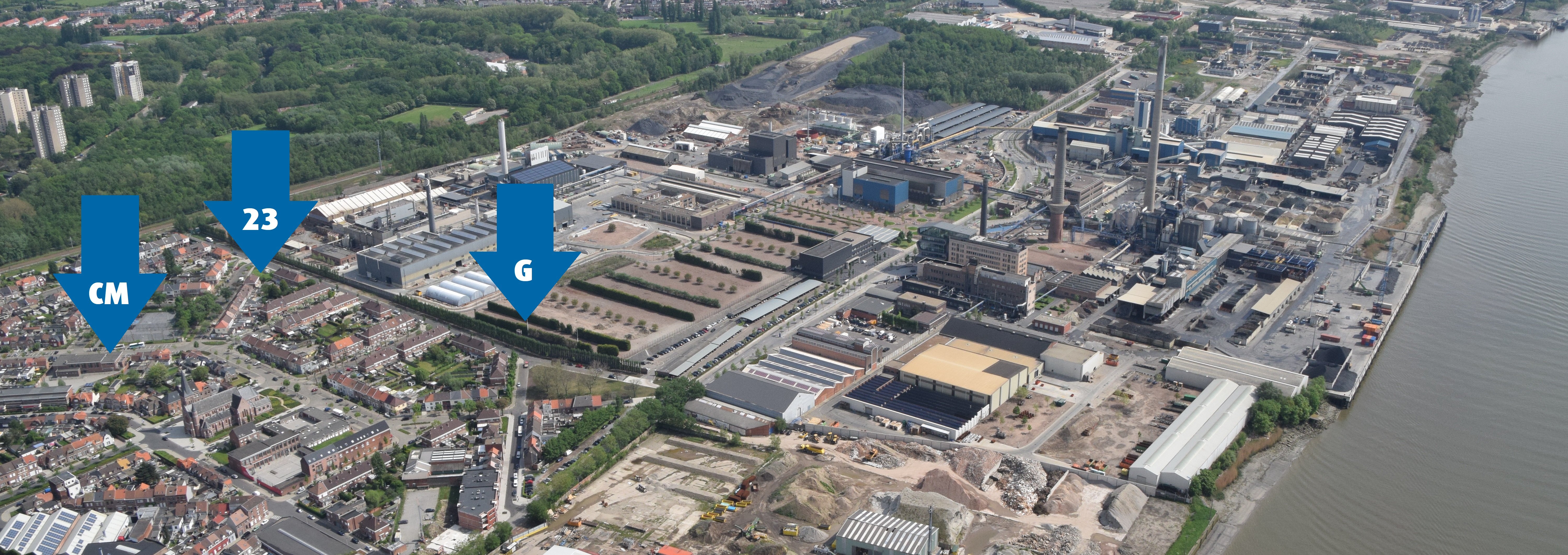
Photo shows measuring post G, on the Umicore site, measuring post 23 closest to the lead refinery, and measuring post CM on the Constantin Meunierplein. The three measurement locations are located northeast of our factory, because the wind mainly blows in that direction. Higher concentrations can therefore be measured there than in places further from the site or in other wind directions.
Every month, we publish our measurement results for the emission of lead, cadmium and arsenic in fine particulate matter (PM10) and coarse particulate matter. We show sliding annual averages (i.e., the average of each of the last 365 days) and the monthly average.
Latest measurement results
Here we publish an update every month of the annual averages (i.e., the average of each of the last 365 days) and the monthly average of our measurements of lead in coarse dust and fine suspended dust.
Lead (Pb)
Lead (Pb) in fine particulate matter (PM10) at measuring points G, CM and 23 to November 2025
The Flemish government imposes a limit value of 500 nanograms per cubic meter for the sliding annual average of lead in fine suspended matter (PM10). A nanogram is one billionth of a gram. We have been staying below this limit value for quite some time.
Pb stands for lead. PM10 stands for fine suspended particulate matter.


Lead (Pb) in coarse dust at measuring points G, CM and 23 to November 2025
There is no limit or target value for lead in coarse dust. However, there is a limit and target value for the average of the monitoring network of the Flemish Environment Agency in the area. Although we are below that limit value, we are not yet achieving the target or guideline value.
Pb stands for lead.


Cadmium (Cd)
Cadmium (Cd) in fine particulate matter (PM10) at measuring points G, CM and 23 up to and including November 2025
The European target or guideline value for cadmium in fine particulate matter is 5 nanograms per cubic meter of air. A nanogram is one billionth of a gram. Umicore meets this European target.
Cd stands for cadmium. PM10 stands for fine suspended particulate matter.


Cadmium (Cd) in coarse dust at measuring points G, CM and 23 up to and including November 2025
For cadmium in coarse dust, there is no limit or target value for an individual measuring point. We are, however, in compliance with a target or guideline value for the average of the monitoring network of the Flemish Environment Agency.
Cd stands for Cadmium.


Arsenic (As)
Arsenic (As) in fine particulate matter (PM10) at measuring points G, CM and 23 up to and including November 2025
The European target or guideline value for arsenic in fine particulate matter is 6 nanograms per cubic meter of air. A nanogram is one billionth of a gram. Unfortunately, we do not yet reach this guideline value. It is a priority to achieve the guideline value.
As stands for arsenic. PM10 stands for fine suspended particulate matter.


Arsenic (As) in coarse dust at measuring points G, CM and 23 up to and including November 2025
There is no mandatory limit value for the annual sliding average of arsenic in coarse dust, no target or guide value, nor for individual measuring points or average of the monitoring network.
As stands for arsenic.


The Flemish Environment Agency is measuring with its own measuring points in the neighborhood.
Read more here (document available in Dutch only)